Events
  Places
  Fish
Fish  Research
  Sign in
  New Catch Log
  New Trip Log
  Research Project
  By Sean Simmons • Aug 8, 2022
 Whirling disease is caused by a microscopic parasite called Myxobolus cerebralis. It affects young salmonids by attacking the cartilage found in the head and spine of young fish, and can have a 90% mortality. This invasive species is a relative newcomer to Alberta, and was first documented in Johnson Lake in Banff National Park in 2016 (Canadian Food Inspection Agency). Since then it has been observed in multiple waterbodies in south-east Alberta and has been linked to a major decline in salmonids in the Crowsnest River.
One of the challenges fisheries managers face is predicting where this invasive species will spread next. Angler data is seen as an important input variable for developing a predictive model because anglers can be one of the vectors for the spread of this disease. Researchers from the University of Alberta (Sam Fischer, Mark Lewis, Mark Poesch and Pouria Ramazi) were able to integrate angler data from MyCatch into the predictive modelling process to help predict where the disease will spread next.
Dr Fischer led the model development, dividing the province into watershed units where he could then apply the model to predict the most likely areas the disease will appear. The results from the model are shown below. The map on the right shows relative movement between watersheds, and the map on the right shows the relative chance on infection, with yellow representing the most likely area where the disease will spread.
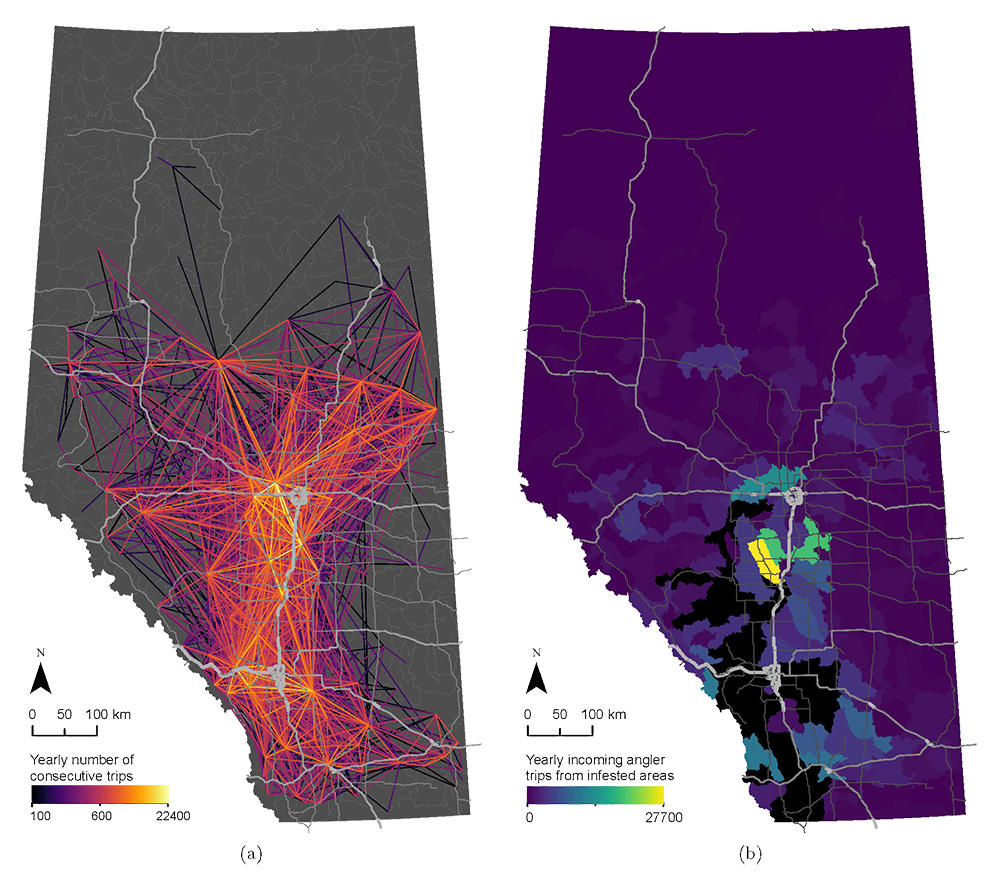
Figure 6: (a) Number of consecutive trips to subbasin pairs and (b) total number of incoming trips by potentially infested anglers. In (a) only subbasin pairs with more than 100 trips per year are shown. In (b) black colours depict subbasins that are already infested (March 2020).
It should be emphasized that these results are theoretical and have not been tested on the ground. But this approach represents an innovative way that citizen science data can help support research across a wide range of scientific inquiry. The paper has been submitted for publication in the Journal of Applied Ecology (yet to be published as of December 29, 2022). You can read the pre-print on Archive X here.