 Events
  Places
  Fish
Fish  Research
  Sign in
  New Catch Log
  New Trip Log
Writeup
Member since April 2015Recent Activity
Dolberg Lake is a popular fishing spot northwest of Barrhead. Each year, the lake is stocked with 18,000 rainbow trout, helping to sustain a thriving fishery.
“Good little lake, good fishing” writes Angler’s Atlas user martin78. “[I] will definitely be back.”
Another Angler’s Atlas user, lancetay, jokes, “there are no fish here, nothing to see, move along,” while holding a fat 6- to 8-lb. rainbow.
Some of the best fishing here is in the fall. Fly fishing can be particularly productive when the waterboatmen are hatching.
The Angler’s Atlas page for Dolberg Lake is at anglersatlas.com/place/101867/dolberg-lake. There you’ll find the location of the hot spot along the southern shore, as well as photos and other useful map markers.
Please note that bait is no longer permitted in Dolberg Lake.
LAKE ACCESS
Located northwest of Edmonton. Take Hwy. 16 west to Highway 43, and turn right. Continue along this road for 25 km to Hwy. 33, and turn right.
Follow this route 43 km north to Barrhead, then west along Hwy. 18 to secondary Hwy. 655, roughly 18 km from the town.
Turn right onto Hwy. 655 and follow it about 25 km. Hwy. 655 takes a sharp turn left at about 3 km, then follows a straight line to the lake, where there is a boat launch. "
5 years ago
Wolf Lake is a popular fishing destination for freshwater anglers, with catches up to six pounds.
Bruce Bolton is the trout specialist at Tyee Marine in Courtenay. He says that late February and March are huge months for this lake.
“The fish are getting ready to spawn at that time,” says Bolton, adding that the fish like “big presentations like Crokodiles, big leeches and big Muddler Minnows ... five, sometimes six inches long.”
The goal is to show strong movement, articulating the lures and flies so they move around. Cutthroat trout will take both insects and smaller fish, and keep in mind that most of the early-season insects will be under the water.
During the summer, trolling and fly fishing are popular on the lake. Worms always work well.
Wolf was not stocked in 2019 but in 2018, the Freshwater Fisheries Society of BC stocked it with 2,500 cutthroat trout.
Visit the lake page for Wolf Lake at anglersatlas.com. This is a great spot to post your fishing tips, photos and map markers.
LAKE ACCESS
Wolf lake is located about 16 km northwest of Courtenay. From the town, follow the Comox Logging Road. Just before passing the Island highway turn right onto the Duncan Bay logging mainline.
There is a boat launch and camping site located on Wolf Lake. According to Angler’s Atlas member drewbags, “Northwest boat launch is accessible; Southeast boat launch is gated off from main road.”
6 years ago
Sproat Lake is very large, deep and quite popular for all manner of water recreational pursuits from swimming to fishing. Despite its size and depth, the water is relatively warm, adding to its value as a destination lake. April and May are good months for steelhead with April through June being especially productive for rainbow trout. The cutthroat fishery on Sproat Lake is catch-and-release only, and all wild rainbows over 60 cm must be released as well.
Although the spring provides the best rainbow trout fishing, Sproat can produce well year-round.. Many anglers go deep in the heat of the summer and troll slowly through the depths. Flatfish and Ford Fenders can work well, and many anglers report great sucess with plugs. While the most productive method of fishing this large beauty is with hardware, fly fishing also nets great results. Try a small marabou leech, trolled slowly around the drop-offs. Another worthwhile method for both gear and flies is to still fish. Anchor in shallower water and cast out.
The Sproat River is an excellent fishery, and is also known locally for great swimming in parts. There are special restrictions in place for Sproat Lake, make sure to consult the Freshwater Fishing Regulations for information.
LAKE ACCESS
From Port Alberni, follow Highway 4 (not 4A), or Johnstone Road through town. Sproat Lake is approximately 14 km west of town. Follow the signs to Sproat Lake Provincial Park. Sproat Lake boasts several campgrounds, each with its own character. Sproat Lake Provincial Park, on the north shore, has two campgrounds. Numerous private campgrounds exist as well.
6 years ago
With its many legs of winding inlets it’s easy to imagine how the forest-ringed centrepiece of Spider Lake Provincial Park came by its name. Explore Spider Lake’s many bays, and take your time; power boats are not allowed here.
Spider Lake is a healthy waterbody with large hatches. This allows for larger than average bass and rainbow trout. Bait fish are a good choice for this lake. Flyfishers have success with wooly buggers and chironomids perform well although windy conditions on this lake can make presentation difficult.
Note that the regulations for Spider Lake have changed this year with a smallmouth bass quota of 4.
In 2019, Spider Lake was stocked with 8,250 rainbow trout.
LAKE ACCESS
Spider Lake Provincial Park is located 16 km west of Qualicum Beach off Hwy. 19. Turn left on the Horne Lake exit then immediately left again and follow signs to Spider Lake Park on a paved road. When the pavement ends, there is a short section of gravel. Watch for the lake on your right.
There is a boat launch beside the parking lot. Motorboats are prohibited. The picnic area and parking lot are open 7 am to 11 pm, mid-May to mid October. A smaller day-use area, open year-round, can be found off Lakeview Rd. less than a kilometre before the main park entrance. This area has two picnic tables, a pit toilet and parking for up to eight vehicles. Small craft can be easily launched from this location.
6 years ago
A popular local lake just outside Campbell River, Roberts Lake supports a thriving rainbow and cutthroat fishery. Fishing is consistently good through the spring, summer and fall, peaking from April to June and through September and October.
Lorna Duncan, from Roberts Lake Resort, says that the best thing about Roberts Lake is that it is a perfect family fishing lake. There is a floating dock, funded jointly between government and private enterprise, that has really helped to made the lake easy to fish. It is a perfect way to get kids out without needing a boat. Duncan adds that there’s also good shore fishing.
Willow Leafs and plugs are the most popular, Duncan notes, and pink or white are good colour choices. Simple techniques work well, she says.
Duncan adds that fly fishing is great in the summer, and that it’s definitely becoming more popular on the lake.
Roberts Lake is deep and cool. The northern shore has large rocks under the water’s surface, making for good trout habitat. Many of the dropoffs are steep, perfect places to start a troll or even to still fish. A sandy beach along the southern part of the eastern side is more gentle. There is a boat launch on the western shore, right down the access road off the highway.
Cutthroat and rainbows can be caught by many of the same methods. Small Flatfish, Kwikfish and Hotshots are really good choices. In general terms, anglers will often catch both rainbows and cutthroats with the same gear.
Early hatches on Roberts Lake are a boon to fly fishers. Chironomids can begin as early as March. While in many places the mayfly hatch doesn’t occur until May, these flies work well as early as April in Roberts Lake.
LAKE ACCESS
Roberts Lake is located next to the Island Hwy. (Hwy. 19) 25 km northwest of Campbell River. Access is excellent on a paved road. Cartop boats can be launched from the lake’s sandy beach, a short walk from the road on a forest service trail to a user-maintained camping area.
Please consult the B.C. Freshwater Fishing Regulations before heading out.
6 years ago
Prospect is a popular swimming, fishing, and boating lake 20 minutes northwest of Victoria in the municipality of Saanich. With mild winters, lush forests, and abundant wildlife, Prospect Lake is cherished by its permanent residents and visitors alike. Prospect benefits from a vibrant volunteer community who work to improve the health of the lake and maintain sensitive habitat through establishment of natural protected areas and invasive management programs.
The lake is stocked yearly and also supports a healthy population of smallmouth bass. 1,347 cutthroat and 8,004 rainbow trout were stocked in 2019. There is shore access but fishing from a boat is by far the preferred method here. Anglers have success casting into the shallows and working the lake’s natural structure.
Bass and trout can both be targeting using small spinners and plastics. For some extra excitement, try a topwater bait like a frog, popper, or prop bait. There’s nothing quite like seeing a bass hammer your lure on a fast retrieve. For the fly anglers, leech patterns with floating line works and chironomid fishing can also be quite productive.
LAKE ACCESS
From Victoria, follow Hwy 17 for 8km and take exit 11, turning left on Royal Oak Dr. After less than a km, turn right on West Saanich Rd and follow north for 4km to Prospect Lake Rd on your left which will take you to Whitehead Park.
There are two carry-in boat launches with access from Estelline Park and Whitehead Park. A trailer boat launch is available from Echo Drive on the northeast corner of the lake but note that parking is limited. There are seasonal toilets at both Whitehead Park and the Echo Boat launch.
Boaters should be aware that there are speed and noise restrictions on Prospect Lake as well as a mandatory counter-clockwise direction of travel within the buoys. Make sure you know the restrictions before heading out on the water and be respectful of private residents.
6 years ago
Fuller Lake provides the rare opportunity to pursue larger trout in a picturesque, easily accessible, semi-urban environment. For these reasons, the lake is a favoured destination for resident and visiting freshwater anglers. Both bass and rainbows are here, which is a boon to anglers who can enjoy very different kinds of fishing in different kinds of conditions.
In 2019, Fuller Lake was stocked with over 7,000 adult and catchable-sized rainbow trout. Local angler, Richard Kennett, says that Fuller Lake is a real family fishing lake, and is oriented towards helping kids learn to fish. There’s a wharf at Fuller Lake which is an ideal spot for kids. “A few times a year, the local clubs put on learn-to-fish programs,” he adds. Fuller Lake is good all year, and Kennett says there are big fish in the lake. “Even at midday, I’ve caught fish there,” he says, noting that morning and later afternoon might be better, but not crucial for catching fish. Kennett suggests that flies are a great choice for Fuller Lake. “Lots of leeches, chironomids. Red Spratleys are good. Even trolling a Wedding Band and worm will work well,” though he reminds anglers that only electric motors are allowed on Fuller Lake. If the trout fishing slows down in the heat, the bass get going. This fishery has been described as lively. Work with surface lures, especially in the morning or evening. Head to shallow water and try soft plastics or crank baits. Please release the bass as soon as possible and as close to where you hooked them as possible; once removed from their nests, their eggs and fry are very vulnerable.
There are special restrictions for Fuller Lake. Be sure to check the regulations before heading out on the water.
LAKE ACCESS
Fuller Lake Park is located on the east side of the Island Highway immediately south of Chemainus Village. Signs mark the turnoff and the lake is accessed by a paved road. There is a boat launch next to a day-use park with a picnic area and washroom facilities. Electric motors only.
6 years ago
For popularity and ease of access, Elk and Beaver Lakes are tough to beat. These conjoined lakes are located directly in Saanich, just north of Victoria.
Adding to the lakes’ accessibility, there is a fishing pier on the northwest side of Elk Lake. Elk Lake was stocked with over 18,000 rainbow trout in 2019. There are bass and perch in Elk / Beaver Lakes, too. These were introduced some years ago.
“Powerbait has been really good lately,” says Jon Bond, Pro Staff at Island Outfitters.
“Talked to some people recently and they’ve had 20-30 trout a day just from shore.”
Bond recommends bubblegum Powerbait as it’s been producing very well so far this year. He says the most effective colours seem to be pink, white, and flourescent yellow.
For bass fishing, Bond recommends Yum Dingers (soft plastic bait), as well as a new product called the Jackal.
When fishing for bass, “you want to be casting close to weed beds and rock structures. Cast and let it sink. Give it little twitches every five to seven seconds,” says Bond.
The Elk Lake pier on the NW shore via Brookleigh Road is wheelchair accessible.
Regulations for Beaver and Elk Lakes have been updated with a smallmouth bass quota of four.
The lake page for Elk and Beaver Lakes at anglersatlas.com is packed full of tips, map markers and coming events.
LAKE ACCESS
Elk Lake: From Victoria take the Pat Bay Hwy towards Sidney. Take left on Sayward drive and then left on Hamsterly Road. Continue to Brookleigh Road and take a right. Just ahead is park entrance.
Beaver Lake: From Victoria take the Pat Bay Hwy towards Sidney. Take the Royal Oak Drive exit, cross over the highway, and take right onto Elk Lake Drive. Park entrance is on your left.
6 years ago
For popularity and ease of access, Elk and Beaver Lakes are tough to beat. These conjoined lakes are located directly in Saanich, just north of Victoria.
Adding to the lakes’ accessibility, there is a fishing pier on the northwest side of Elk Lake. Elk Lake was stocked with over 18,000 rainbow trout in 2019. There are bass and perch in Elk / Beaver Lakes, too. These were introduced some years ago.
“Powerbait has been really good lately,” says Jon Bond, Pro Staff at Island Outfitters.
“Talked to some people recently and they’ve had 20-30 trout a day just from shore.”
Bond recommends bubblegum Powerbait as it’s been producing very well so far this year. He says the most effective colours seem to be pink, white, and flourescent yellow.
For bass fishing, Bond recommends Yum Dingers (soft plastic bait), as well as a new product called the Jackal.
When fishing for bass, “you want to be casting close to weed beds and rock structures. Cast and let it sink. Give it little twitches every five to seven seconds,” says Bond.
The Elk Lake pier on the NW shore via Brookleigh Road is wheelchair accessible.
Regulations for Beaver and Elk Lakes have been updated with a smallmouth bass quota of four.
The lake page for Elk and Beaver Lakes at anglersatlas.com is packed full of tips, map markers and coming events.
LAKE ACCESS
Elk Lake: From Victoria take the Pat Bay Hwy towards Sidney. Take left on Sayward drive and then left on Hamsterly Road. Continue to Brookleigh Road and take a right. Just ahead is park entrance.
Beaver Lake: From Victoria take the Pat Bay Hwy towards Sidney. Take the Royal Oak Drive exit, cross over the highway, and take right onto Elk Lake Drive. Park entrance is on your left.
6 years ago
Located in the majestic and towering Sayward Forest, one of Echo Lake’s best features is that it is accessible for everyone (including people who use wheelchairs). It was developed to encourage families and visitors to get out and get fishing.
Each June, the BC Freshwater Fisheries Society hosts events for Family Fishing Weekend. Echo Lake is one of Vancouver Island’s Family Fishing Waters. In 2020, Family Fishing Weekend is June 19-21.
Echo Lake supports a thriving fishery for cutthroat, kokanee, and Dolly Varden, and rainbows are stocked regularly to round out the fishing experience. In 2019, 2,500 rainbow trout were released in Echo Lake.
One of the lake’s unique features is that it is fed by a very large number of underground springs. This not only keeps the water in the lake circulating, but also brings in an abundance of food for the fish. As a result, some of Echo Lake’s trout have been known to reach over 15 pounds. This is an exceptional size, and many more are in the still-large 5 pound range.
Echo Lake is also somewhat unique in that it can challenge experts while still being easy enough for beginners to fish. You can try out your new fly patterns and lures, and you’ll often still catch fish with basic gear.
If you want to get fancy, though, good colour choices for Echo Lake are chrome or nickel combinations. Krokodiles in chrome / orange, silver speckled Kwikfish or red / nickel Dick Nite spoons are good producers.
The Carey Special and the Doc Spratley are excellent attractor patterns any time of the year. Other common patterns that produce good results are the Pheasant-tail Nymph, 52 Buick, Halfback and Baggie Shrimp. Flies can be trolled with a full sink line in 20–38 cm (8–15 inches) of water, close to the bottom, or cast and retrieved. Varying your speed while trolling or retrieving the fly can be effective at enticing fish to bite.
LAKE ACCESS
Echo Lake is located 20 km southwest of Campbell River on Hwy 28 to Gold River and is easily accessed at two locations directly off the highway. Boat launch. Electric motors only. Campsites are located nearby, as well as at Echo Lake Resort. The Fish and Game Society, along with the Freshwater Fisheries Society, is currently upgrading the dock and the day-use area.
6 years ago
Located on the western boundary of Strathcona Provincial Park, Drum Lake is a beautiful lake, stocked with trout and excellent for fly fishing.
Drum Lake’s two basins have great shore fishing opportunities, especially on the section between the two basins. If you feel like exploring deeper sections, boating is good too, though be wary of the shallower west basin.
Drum Lake is stocked with cutthroat and rainbow trout, and is a natural habitat for Dolly Varden and kokanee. Stick to some of the shallower areas in the spring and fall if you’re trolling. The weedy areas around the shore are prime habitat. Prime time to fish is in the spring and fall months.
Rainbow trout seem unable to resist small plugs in this lake. Small spoons and spinners produce results as well. Drum Lake has a good chironomid hatch. Other standard patterns, like Leeches and Nymphs are useful.
LAKE ACCESS
Access is right off Hwy 28 on a paved road, 19 kilometres northeast of Gold River, or 73 km west of Campbell River. There are two parking areas. One is located at Crest Creek on the lower basin, although the best spot to park is the pullout at the Elk River trailhead between the lower and upper basins. The cartop boat launch is 150 metres west of the Elk River lot. Although the lake is quite near the highway, access can be tricky: you might need to park your vehicle and walk to get fishing. There is a cartop boat launch across the highway from the Elk River trailhead parking lot, a picnic spot and a pebble beach for swimming in a day-use park. Don’t plan on an overnighter, though: there aren’t any campsites or resorts nearby. As always, be careful and make sure to pack emergency gear, food, and warm clothes, especially if you intend to go off-trail. Other fishing lakes within the park are Upper Campbell Lake and Buttle Lake.
6 years ago
“November is the best month for fishing Comox Lake,” says local trout specialist, Bruce Bolton. The most popular lure is a Tomic plug.
These plugs are used to represent kokanee, often with orange on the bellies. Spoons also work well.
In the summer months a lot of anglers use Flatfish and run Rooster Tails, says Bolton. Spin casting with Panther Martins andCrokodiles is also popular.
Small Tomic plugs, Flatfish and Rapalas are popular trolling lures in the lake.
In the summer, fly fishing can be very productive in “The Stump”
area, where the Puntledge River runs into the lake.
“It’s quite shallow and just full of stumps...a really good place to work a fly.”
Some of the key hatches are chironomids and ants. “The ant hatch comes out the end of May, but you want to fish this pattern just before the big hatch happens.
“Some of the lakes just get covered in ants, so you really want to fish them before the real hatch, and then after. Otherwise you are just throwing a fly in there with ten million more.”
Bolton also recommends trying out the higher elevation lakes, up to Paradise Meadows. Once the snow goes, it can be great fishing up there.
New regulations for Comox Lake read “no wild rainbow trout over 50 cm.”
Comox Lake is a part of the Cutthroat Trout Reward Tag Program. $100 reward tags are being used to assess the cutthroat trout fishery. Refer to the regulations guide for instructions on what to do if you catch a fish with a reward tag.
If you’ve got information on upcoming events, or if you want to add your own fishing tips, check out our lake page for Comox Lake at anglersatlas.com
LAKE ACCESS
From Cumberland, follow Dunsmuir Ave. west to Sutton Rd., then turn left. About 200 metres later turn right onto Comox Lake Road and follow it about four km to the Cumberland Lake Park Campground.
There is also a BC Hydro Picnic area at the outlet to Puntledge River at the north end of the lake.
6 years ago
Cowichan Lake is one of the jewels of British Columbia. It offers easy access and excellent fishing and recreational opportunities. Its stunning scenery showcases some of the best of Vancouver Island, making Cowichan Lake very popular with tourists and locals alike.
There is a lot to explore. One could spend a very long time on Cowichan Lake and still not experience all it has to offer.
Local fishing guide, Marcus Kennett, fishing guide offers some great tips to help you make the most of your trip.
“There is good trout fishing for rainbows and cutthroat trout all year, but I like to fish it in the winter and spring,” he suggests. “It is a bigger lake, so fishing out of a boat does give you more options and opportunities. I like to fish in front of some of the tributaries that flow into the lake in the winter when the fish eggs are coming out of the creeks, when the salmon are spawning, and in the spring when all of the salmon fry are coming out of the creeks.”
Kennett’s lures of choice for trout in Cowichan Lake are 3” Tomic Plugs. His favourite colours are: #632iig, #231, #351, #602 #256ii, #232, and #619. Also try 3.5” Coyote spoons in Army Truck, Cop Car and Glo Green; Diawa Dr Minnow in Prizm shade; Rainbow Trout from 2” to 3 1/2”; Rapala plugs in black and silver; and Rainbow Trout in sizes CD11 or F11.
Kennett notes that his favourite fly patterns for lake are “all of the same flies that I use in the river for trout.” The Cowichan River Guide Fly works very well and is very popular.
“Some other favourites are Doc Spratlies in red and black and green, Muddler Minnows, Wooly Buggers, Stone Flies, Cased Caddis Flies, Tom Thumbs, May Flies, Sedge, Irresistibles and Mosquitoes,” says Kennett.
LAKE ACCESS
From the town of Lake Cowichan, west of Duncan, there are several access points to the lake. Visit the info centre in town or one of the local tackle shops for information about the many places to launch boats in the lake.
There are several accommodation options as well, ranging from rustic camping to more serviced campsites to motels and hotels in town.
6 years ago
Not a remote lake, Cameron Lake is located within driving distance of most mid-Island centres. Despite a generally beautiful and warm summer, this lake remains cold, and the fish remain active throughout the warm weather. Fishing is great all year round, with the trophy sized fish being caught after the kokanee spawn of late fall.
During the summer, fish tend to be hiding along the south side of the lake, close to the camping areas of McMillian Provincial Park. Although not particularly deep, there are many channels with cool water that house many fish. Brown trout in particular are night-feeders, meaning late evening or at night is when the lake is most active.
Try using a large coloured minnow pattern in the 4-6” range. Reds and burgundies are known to have some success, however the fish are fairly open to most colours. If you’re a fly fisher, Dark Bunny leeches or dragonfly patterns work well.
LAKE ACCESS
Cameron Lake is located east of Port Alberni along Highway 4. From Port Alberni, head east along Highway 4 for about 26 kilometres.
Several camping and accommodation options exist around Cameron Lake. Little Qualicum Falls Provincial Park has campsites and amenities. Cameron Lake Lodge is a private campground on Cameron Lake offering camping and a boat launch.
Boaters need to be aware that the lake is subject to sudden strong gusts of wind. Anglers with smaller boats need to take appropriate precautions when venturing into Cameron Lake.
There are great opportunities for swimming and sailing on Cameron Lake, and nearby hiking trails are an excellent way to explore the area. McMillan Provincial Park with its spectacular old-growth forest, and Little Qualicum Falls are other prime attractions here.
6 years ago
The west coast of Vancouver Island is one of the most productive fishing waters in the world and Tahsis is centred right in the middle of it.
Whether you are going after the world-class prawning grounds in Tahsis Inlet, some big ling cod and halibut along the coast, or the famous Conuma River salmon run in late July, Tahsis offers year-round fishing adventures.
There are four major fishing areas easily reached from Tahsis—Tahsis Inlet, Esperanza Inlet, Nootka Sound and Tlupana Inlet.
Each one of these locations holds a unique fishing experience.
Tahsis Inlet is famous for its productive prawning, and is the only place open year-round. John Falavolito, owner of Westview Marina and Lodge in Tahsis, says prawns are near steep drop-offs in about 75 to 100 metres of water.
Falavolito gives one final tip for prawning. “Don’t use fresh fish of any kind. If you do, your traps will be full of slime eels rather than loaded with delicious prawns.”
Esperanza Inlet has experiences to offer anglers, any time of the year. Just off the coast is Six Mile Reef and The Pinnacles. Both are great locations to fish for halibut. You can also catch the salmon as they head into the inlet.
“Lots of people fish the ebb tide [of Six Mile Reef] for halibut and then get their salmon“ says Falavolito.
Moving into Esperanza Inlet, you will pass a number of great fishing locations, such as Double Island, Rosa Harbour and Blind Reef.
He describes the Whale’s tail as “worth its weight in gold. Its structure on the bottom looks just like a whale’s tail ... and the fish hold in this depression.”
Exceptional fishing opportunities exist throughout the inlet, from early spring to late fall. With a little help from Westview Marina, you can be sure to find the hottest fishing spots any time of the year.
Maquinna Point, at the south end of Nootka Island, is one of the first hot spots as the Connuma fish enter Nootka Sound. This is because the bait stacks up here, along the big rocks.
Moving into the sound, along the south side of the island, anglers can try out Wash Rocks, San Miguel Islands and Friendly Cove for more great places to fish.
A lot of salmon travel up Zuciarte Channel—a narrow but deep stretch of water. Fish the walls up and down the channel, mainly the down-island side. Chinook fishing is good from May to August.
Tlupana Inlet begins just past the north tip of Bligh Island and this is where the Conuma River salmon run converges. Fishing this run starts mid-July and runs about two to three weeks.
“Anywhere from 250,000 to 400,00 fish come back,” says Falavolito. “You can fish the mouth of the river, into the estuary and up the river as well, from the hatchery down.”
If you time the run right, the fishing is unbelievable. Three good spots to cover are Hoiss Point, San Carlos Point and Camel Rock.
There are also number of volunteer hatcheries that enhance the quality and quantity of fishing opportunities in the Campbell River area.
For more information about fishing this section of Vancouver Island’s west coast, call John at Westview Marina and Lodge. Call 250-934-7672 or email to [email protected]. Also visit anglersatlas.com and search for Esperanza, Nootka, and Tahsis.
6 years ago
All species of salmon can be found in Barkley Sound, as it sits along major migratory path for salmon from Alaska, as well as being connected to extensive streams and rivers that provide excellent spawning grounds.
Amphritite Point, near the town of Ucluelet, is popular for chinook salmon in the summer, with Newcomb Channel also providing some earlier spring fishing. Moving east into the sound, Toquart Bay is another popular fishing location. The area is relatively sheltered and can provide some cover from the open ocean. Another sheltered location that is good for trolling is along Sechart Channel.
Barkley Sound is also the gateway to Port Alberni, via the Alberni Inlet. There are a number of great fishing locations near the inlet. Try hugging the shore along Junction Passage and into Rainy Bay.
Trevor Channel runs from the Alberni Inlet to Cape Beale, providing a number of excellent fishing spots all along the southern shore. Cape Beale is known as a hot spot, especially for moochers and jiggers. The village of Bamfield is also located along this channel.
A series of islands (Tzartus Fleming, Diana, Edward King) separate Trevor Channel from the open water of Imperial Eagle Channel. Where Imperial Eagle Channel meets the open Pacific, a cluster of islands (the largest being Effingham) are also great fishing locations. Try trolling around the islands.
Barkley Sound is known for its sheltered waters and excellent fishing. According to Tourism Ucluelet, Barkley Sound has the best fishing in the Pacific Northwest.
Barkley Sound is home to cod, flounder, halibut and sole, not to mention all species of Pacific salmon, ling cod, and all kinds of shellfish. While West Coast salmon is often the draw, anglers have the chance to catch dozens of other types of fish, or just sit back and enjoy the beauty of the Sound.
Local angler Shane Hagen says that year-round, you can catch all types of fish migrating up through different river systems along the coast. “Find the right bait, and you’ll definitely catch something,” he says.
Hagen notes that from June through August, sockeye run right up to the Robertson Creek Hatchery. For all species, you’re allowed to keep between two and four per person, depending on the species. Sockeye run between three and ten pounds, he says.
In July, the chinook runs begin. These go up to the hatchery as well, and can be from 15 to 60 pounds, “if you’re lucky,” Hagen says. chinook run until October.
Anglers will be lucky around this time as well, because the coho are also running, usually between August and October.
Hagen suggests that his first choice of bait is anchovy. He finds that the salmon are keen on these, though you can try others as well. “Try Coyote Spoons, or green and white Hoochies,” he says.
“For sockeye, I’d go with a pink and red Hoochie. Sockeye seem to like pink and red,” he says.
Head for Nahmint Bay and China Creek for sockeye, Hagen suggests. For chinook and coho, try Kirby Point, Cree, or Effingham Island. Also Muir’s Bluff is a good place to try.
Later on, for coho or chinook, try Pill Point or Diplock.
People fishing in Barkley Sound are going for other types of fish besides salmon. The halibut and ling cod fisheries are very popular.
“Anchor up on a high spot, any muddy or sandy area, for halibut between 250 to 300 feet deep. Anchor up, and jig for halibut.” For bait, Hagen says that herring, octopus, or salmon bellies are all good choices.
For ling cod, Hagen says that any pinnacle or rocky section can be a good starting point. “The only thing to watch for, though, is the Broken Group Islands, because that area is closed to ling cod fishing. It’s a juvenile breeding ground, and the ling cod are protected from interference there.”
Hagen reminds anglers that while Barkley Sound as a whole is sheltered compared to the open ocean, it can still be “weathery.” Anglers really need seaworthy boats and navigation equipment. The latter becomes particularly critical in the fog, and Hagen says that in August and September, “you will get fogged in, without a doubt.”
The other important point to note is that Barkley Sound is a working inlet, and there are several commercial vessels passing through the area. Hagen reminds people to watch for logs, and to always read the regulations. There are many closed areas, and there is always something that requires extra checking, whether it be catch quotas or size limits.
Beyond the fishing, there is a huge array of options, from hiking to diving, with kayaking being among the most popular activities.
The Broken Group Islands, and the Pacific Rim National Park Reserve, are kayak-friendly waters that give paddlers a chance to see humpback whales, eagles, sea lions, and bears. The Broken Group Islands Unit is made up of over 100 islands and rocky areas scattered between Loudoun Channel and Imperial Eagle Channel in the middle of Barkley Sound.
There are various spots to camp, and experienced kayakers can follow well-travelled kayak routes throughout the area. (Be sure you have guidance equipment, and as always, we recommend hiring a guide or going with a tour group if you’re unfamiliar with the area.)
Anglers and tourists will also find no shortage of accommodation options in and around Barkley Sound. The towns of Ucluelet and Port Alberni offer a range of lodging from campgrounds to hotels, as well as mooring for boats.
The Pacific Rim National Park Reserve is another option, with campsites on the more rugged side throughout the park. Please be mindful that most of these spots do not offer amenities of any sort, and require campers to pack out everything they pack in. There are seven different campgrounds in this group, most of which are small, and again, unserviced. They are popular, however, so trip-planning can be especially important, and if at all possible, try to avoid peak seasons.
Be sure to consult regulations for this area before heading out, closures and restriction changes are ongoing so make sure you have the most up-to-date information prior to your trip.
6 years ago
Excellent salmon and halibut fishing, and breathtaking scenery in Sooke. Tory Howe from Goin Coastal Fishing Charters tells us “The Strait of Juan de Fuca, and the Sooke Harbour is friendly water,” he adds. “There aren’t too many people who get seasick.”
Fishing is great year-round in this area but winter salmon fishing can be particularly productive. Bottom fishign for halibut and ling cod is popular as well as trapping dungeness crab. Crab traps can be purchased or rented at the Sooke Harbour.
There are several available fishing charters with reasonable rates that provide you with everything you need for a successful day on the water.
The fishing is non-stop action, too. Howe tells of a time when he was guiding a couple who were out for halibut. While they waited for the tide to be right, they decided to take a chance on some chinook, resulting in an epic 15 minute battle with a forty pound salmon.
“Our fish totes are often full of big fish. When the bite goes off you get carried away, and we have to keep recounting to make sure we’re staying in our limits!”
Prestige Hotels sponsors the Sooke Saltwater Series, a combined salmon and halibut tournament. For $150, you can compete in three derbies. Points are awarded, with several chances to score big and win huge prizes. Al Kennedy from Reel Excitement Charters says, “Even if you don’t win the halibut derby, you’ve got two more chances to win overall”.
Jesse Legg, from Sea Leggs Fishing Adventures, adds that the derby is also a chance to do some good. “At the end of each derby, if you buy a ticket and donate a fish, you win a prize. The fish are vacuum sealed and donated to a local shelter for food. Everyone wins.”
The Saltwater Series begins with the Halibut Derby in May, followed by the Coho Derby in October, and the Boxing Day Derby in December. Prestige Oceanfront Resort hosts a reception at the end of each derby. See more at sookesaltwaterseries.ca.
Recent closures and restrictions have been put in place for the Sooke area. Make sure you are fully informed of the current regulations before heading out on the water. If you are not from the area, we strongly encourage hiring a guide to increase your chances of success, and to make sure that you are in compliance with current regulations.
6 years ago
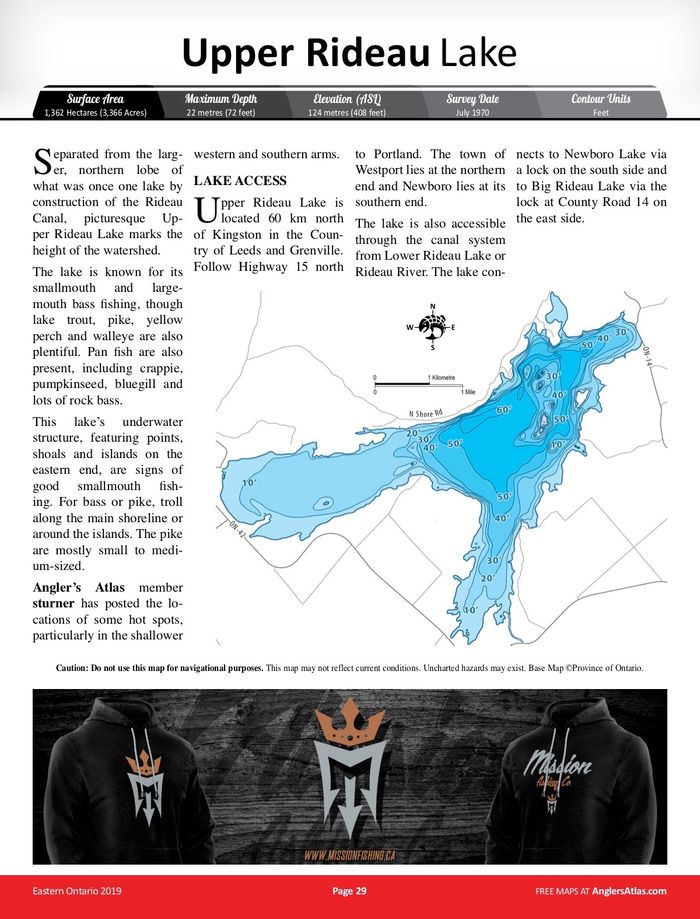
Separated from the larger, northern lobe of what was once one lake by construction of the Rideau Canal, picturesque Upper Rideau Lake marks the height of the watershed.
The lake is known for its smallmouth and largemouth bass fishing, though lake trout, pike, yellow perch and walleye are also plentiful. Pan fish are also present, including crappie, pumpkinseed, bluegill and lots of rock bass.
This lake’s underwater structure, featuring points, shoals and islands on the eastern end, are signs of good smallmouth fishing. For bass or pike, troll along the main shoreline or around the islands. The pike are mostly small to medium-sized.
Angler’s Atlas member sturner has posted the locations of some hot spots, particularly in the shallower western and southern arms.
LAKE ACCESS
Upper Rideau Lake is located 60 km north of Kingston in the Country of Leeds and Grenville. Follow Highway 15 north to Portland. The town of Westport lies at the northern end and Newboro lies at its southern end.
The lake is also accessible through the canal system from Lower Rideau Lake or Rideau River. The lake connects to Newboro Lake via a lock on the south side and to Big Rideau Lake via the lock at County Road 14 on the east side.
7 years ago
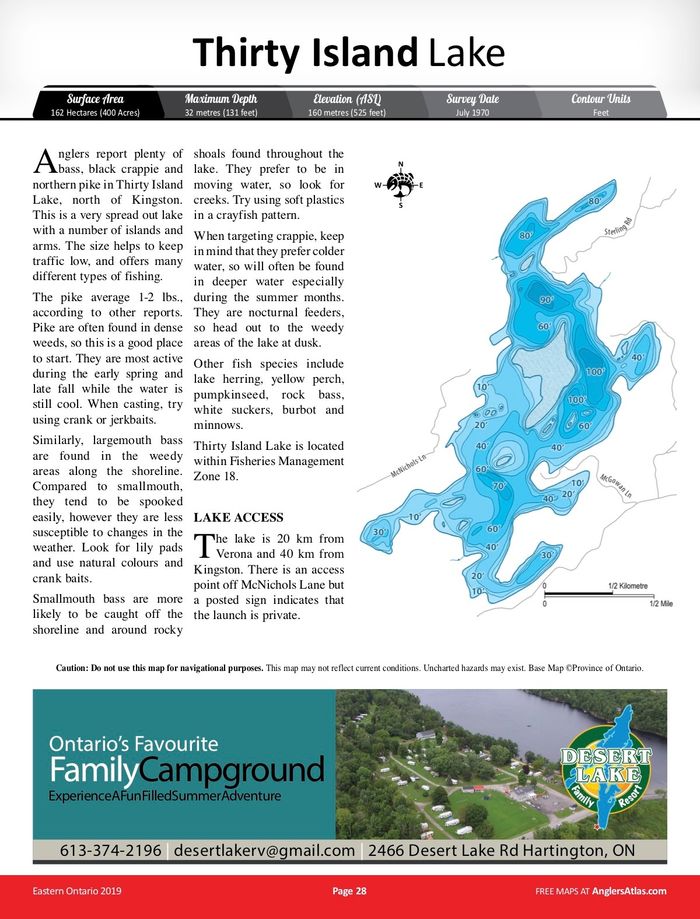
Anglers report plenty of bass, black crappie and northern pike in Thirty Island Lake, north of Kingston. This is a very spread out lake with a number of islands and arms. The size helps to keep traffic low, and offers many different types of fishing.
The pike average 1-2 lbs., according to other reports. Pike are often found in dense weeds, so this is a good place to start. They are most active during the early spring and late fall while the water is still cool. When casting, try using crank or jerkbaits.
Similarly, largemouth bass are found in the weedy areas along the shoreline. Compared to smallmouth, they tend to be spooked easily, however they are less susceptible to changes in the weather. Look for lily pads and use natural colours and crank baits.
Smallmouth bass are more likely to be caught off the shoreline and around rocky shoals found throughout the lake. They prefer to be in moving water, so look for creeks. Try using soft plastics in a crayfish pattern.
When targeting crappie, keep in mind that they prefer colder water, so will often be found in deeper water especially during the summer months. They are nocturnal feeders, so head out to the weedy areas of the lake at dusk.
Other fish species include lake herring, yellow perch, pumpkinseed, rock bass, white suckers, burbot and minnows.
Thirty Island Lake is located within Fisheries Management Zone 18.
LAKE ACCESS
The lake is 20 km from Verona and 40 km from Kingston. There is an access point off McNichols Lane but a posted sign indicates that the launch is private.
7 years ago
St.Lawrence River - Gananoque
All water flowing from the Great Lakes passes through the St. Lawrence River, making it one of the largest river systems in the country. Throughout this river, there are more than 20 species of sport fish to target.
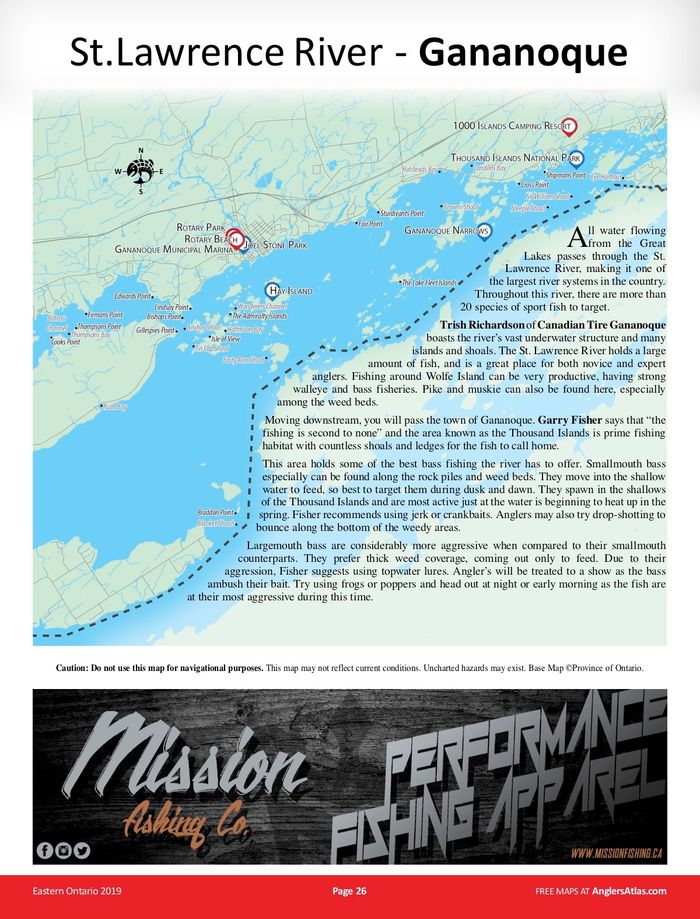
Trish Richardson of Canadian Tire Gananoque boasts the river’s vast underwater structure and many islands and shoals. The St. Lawrence River holds a large amount of fish, and is a great place for both novice and expert anglers. Fishing around Wolfe Island can be very productive, having strong walleye and bass fisheries. Pike and muskie can also be found here, especially among the weed beds.
Moving downstream, you will pass the town of Gananoque. Garry Fisher says that “the fishing is second to none” and the area known as the Thousand Islands is prime fishing habitat with countless shoals and ledges for the fish to call home.
This area holds some of the best bass fishing the river has to offer. Smallmouth bass especially can be found along the rock piles and weed beds. They move into the shallow water to feed, so best to target them during dusk and dawn. They spawn in the shallows of the Thousand Islands and are most active just at the water is beginning to heat up in the spring. Fisher recommends using jerk or crankbaits. Anglers may also try drop-shotting to bounce along the bottom of the weedy areas.
Largemouth bass are considerably more aggressive when compared to their smallmouth counterparts. They prefer thick weed coverage, coming out only to feed. Due to their aggression, Fisher suggests using topwater lures. Angler’s will be treated to a show as the bass ambush their bait. Try using frogs or poppers and head out at night or early morning as the fish are at their most aggressive during this time.
St.Lawrence River - Brockville
Further downstream, the river narrows and the current picks up speed approaching Brockville. Some of the largest muskies have been pulled out of the St. Lawrence River in this area, as well as has one of the most productive walleye fisheries. Pike, perch, and bass can also be found along the weed beds and islands, along with many other species.
Typically, fishing is strongest between June and September. For those targeting muskie, you may want to extend that season into October and November, when the muskie come up to the shallower depths as the water cools. Look along the shoals and around the islands. Muskie prefer to be in 15 to 30 feet of water, and respond well to trolling lure such as Stalkers, Ernies, or Kriscos.
It is not uncommon to catch northern pike over 10 pounds. They can usually be found in the shallows as they move into warmer water during the spring to feed. Pike are usually found with largemouth bass, so look for dense weeds that provide lots of cover. Spinners, Crankbaits and Jerkbaits have all been proven for pike, and using a flurocarbon fishing line is recommended.
7 years ago
The Rideau River takes its name from a “curtain of water,” the waterfall where it drains into the Ottawa River in the nation’s capital.
“The Rideau’s got bass, pike, pickerel and musky,” says staff at Canadian Tire in Kempville. “Your best bait is pretty much spinners and plastic.”
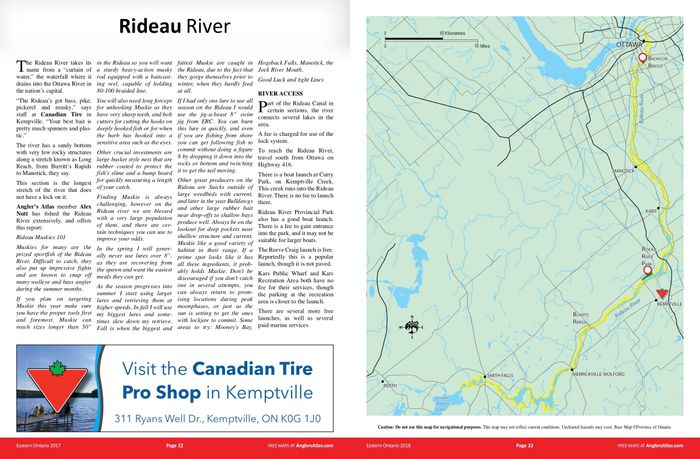
The river has a sandy bottom with very few rocky structures along a stretch known as Long Reach, from Burritt’s Rapids to Manotick, they say.
This section is the longest stretch of the river that does not have a lock on it.
Angler’s Atlas member Alex Nutt has fished the Rideau River extensively, and offers this report:
Rideau Muskies 101
Muskies for many are the prized sportfish of the Rideau River. Difficult to catch, they also put up impressive fights and are known to snap off many walleye and bass angler during the summer months.
If you plan on targeting Muskie this year make sure you have the proper tools first and foremost. Muskie can reach sizes longer than 50” in the Rideau so you will want a sturdy heavy-action musky rod equipped with a baitcasting reel, capable of holding 80-100 braided line.
You will also need long forceps for unhooking Muskie as they have very sharp teeth, and bolt cutters for cutting the hooks on deeply hooked fish or for when the barb has hooked into a sensitive area such as the eyes.
Other crucial investments are large basket style nets that are rubber coated to protect the fish’s slime and a bump board for quickly measuring a length of your catch.
Finding Muskie is always challenging, however on the Rideau river we are blessed with a very large population of them, and there are certain techniques you can use to improve your odds.
In the spring I will generally never use lures over 8”, as they are recovering from the spawn and want the easiest meals they can get.
As the season progresses into summer I start using larger lures and retrieving them at higher speeds. In fall I will use my biggest lures and sometimes slow down my retrieve. Fall is when the biggest and fattest Muskie are caught in the Rideau, due to the fact that they gorge themselves prior to winter, when they hardly feed at all.
If I had only one lure to use all season on the Rideau I would use the jig-a-beast 8” swim jig from ERC. You can burn this lure in quickly, and even if you are fishing from shore you can get following fish to commit without doing a figure 8 by dropping it down into the rocks or bottom and twitching it to get the tail moving.
Other great producers on the Rideau are Suicks outside of large weedbeds with current, and later in the year Bulldawgs and other large rubber bait near drop-offs to shallow bays produce well. Always be on the lookout for deep pockets near shallow structure and current. Muskie like a good variety of habitat in their range. If a prime spot looks like it has all these ingredients, it probably holds Muskie. Don’t be discouraged if you don’t catch one in several attempts, you can always return to promising locations during peak moonphases, or just as the sun is setting to get the ones with lockjaw to commit. Some areas to try: Mooney’s Bay, Hogsback Falls, Manotick, the Jock River Mouth.
Good Luck and tight Lines
RIVER ACCESS
Part of the Rideau Canal in certain sections, the river connects several lakes in the area.
A fee is charged for use of the lock system.
To reach the Rideau River, travel south from Ottawa on Highway 416.
There is a boat launch at Curry Park, on Kemptville Creek. This creek runs into the Rideau River. There is no fee to launch there.
Rideau River Provincial Park also has a good boat launch. There is a fee to gain entrance into the park, and it may not be suitable for larger boats.
The Reeve Craig launch is free. Reportedly this is a popular launch, though it is not paved.
Kars Public Wharf and Kars Recreation Area both have no fee for their services, though the parking at the recreation area is closer to the launch.
There are several more free launches, as well as several paid marina services.
7 years ago
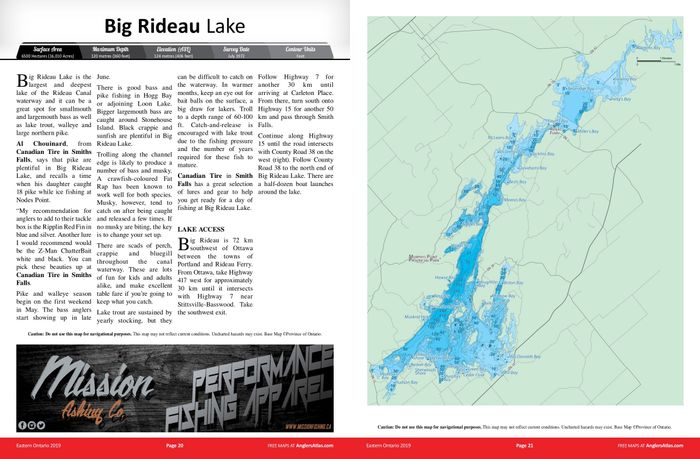
Big Rideau Lake is the largest and deepest lake of the Rideau Canal waterway and it can be a great spot for smallmouth and largemouth bass as well as lake trout, walleye and large northern pike.
Al Chouinard, from Canadian Tire in Smiths Falls, says that pike are plentiful in Big Rideau Lake, and recalls a time when his daughter caught 18 pike while ice fishing at Nodes Point.
“My recommendation for anglers to add to their tackle box is the Ripplin Red Fin in blue and silver. Another lure I would recommend would be the Z-Man ChatterBait white and black. You can pick these beauties up at Canadian Tire in Smiths Falls.
Pike and walleye season begin on the first weekend in May. The bass anglers start showing up in late June.
There is good bass and pike fishing in Hogg Bay or adjoining Loon Lake. Bigger largemouth bass are caught around Stonehouse Island. Black crappie and sunfish are plentiful in Big Rideau Lake.
Trolling along the channel edge is likely to produce a number of bass and musky. A crawfish-coloured Fat Rap has been known to work well for both species. Musky, however, tend to catch on after being caught and released a few times. If no musky are biting, the key is to change your set up.
There are scads of perch, crappie and bluegill throughout the canal waterway. These are lots of fun for kids and adults alike, and make excellent table fare if you’re going to keep what you catch.
Lake trout are sustained by yearly stocking, but they can be difficult to catch on the waterway. In warmer months, keep an eye out for bait balls on the surface, a big draw for lakers. Troll to a depth range of 60-100 ft. Catch-and-release is encouraged with lake trout due to the fishing pressure and the number of years required for these fish to mature.
Canadian Tire in Smith Falls has a great selection of lures and gear to help you get ready for a day of fishing at Big Rideau Lake.
LAKE ACCESS
Big Rideau is 72 km southwest of Ottawa between the towns of Portland and Rideau Ferry. From Ottawa, take Highway 417 west for approximately 30 km until it intersects with Highway 7 near Stittsville-Basswood. Take the southwest exit.
Follow Highway 7 for another 30 km until arriving at Carleton Place. From there, turn south onto Highway 15 for another 50 km and pass through Smith Falls.
Continue along Highway 15 until the road intersects with County Road 38 on the west (right). Follow County Road 38 to the north end of Big Rideau Lake. There are a half-dozen boat launches around the lake.
7 years ago
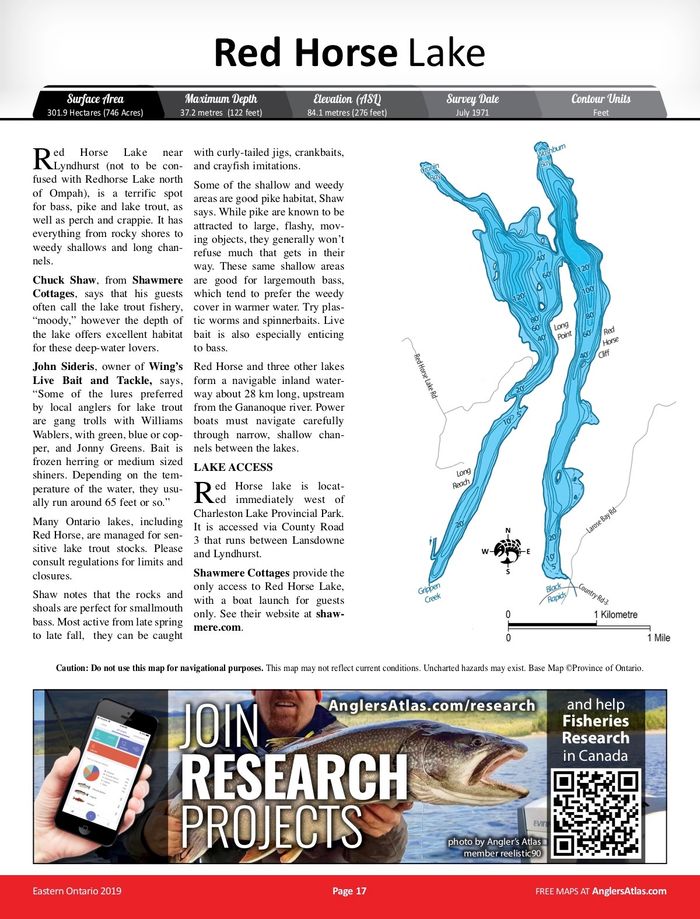
Red Horse Lake near Lyndhurst (not to be confused with Redhorse Lake north of Ompah), is a terrific spot for bass, pike and lake trout, as well as perch and crappie. It has everything from rocky shores to weedy shallows and long channels.
Chuck Shaw, from Shawmere Cottages, says that his guests often call the lake trout fishery, “moody,” however the depth of the lake offers excellent habitat for these deep-water lovers.
John Sideris, owner of Wing’s Live Bait and Tackle, says, “Some of the lures preferred by local anglers for lake trout are gang trolls with Williams Wablers, with green, blue or copper, and Jonny Greens. Bait is frozen herring or medium sized shiners. Depending on the temperature of the water, they usually run around 65 feet or so.”
Many Ontario lakes, including Red Horse, are managed for sensitive lake trout stocks. Please consult regulations for limits and closures.
Shaw notes that the rocks and shoals are perfect for smallmouth bass. Most active from late spring to late fall, they can be caught with curly-tailed jigs, crankbaits, and crayfish imitations.
Some of the shallow and weedy areas are good pike habitat, Shaw says. While pike are known to be attracted to large, flashy, moving objects, they generally won’t refuse much that gets in their way. These same shallow areas are good for largemouth bass, which tend to prefer the weedy cover in warmer water. Try plastic worms and spinnerbaits. Live bait is also especially enticing to bass.
Red Horse and three other lakes form a navigable inland waterway about 28 km long, upstream from the Gananoque river. Power boats must navigate carefully through narrow, shallow channels between the lakes.
LAKE ACCESS
Red Horse lake is located immediately west of Charleston Lake Provincial Park. It is accessed via County Road 3 that runs between Lansdowne and Lyndhurst.
Shawmere Cottages provide the only access to Red Horse Lake, with a boat launch for guests only. See their website at shawmere.com.
7 years ago
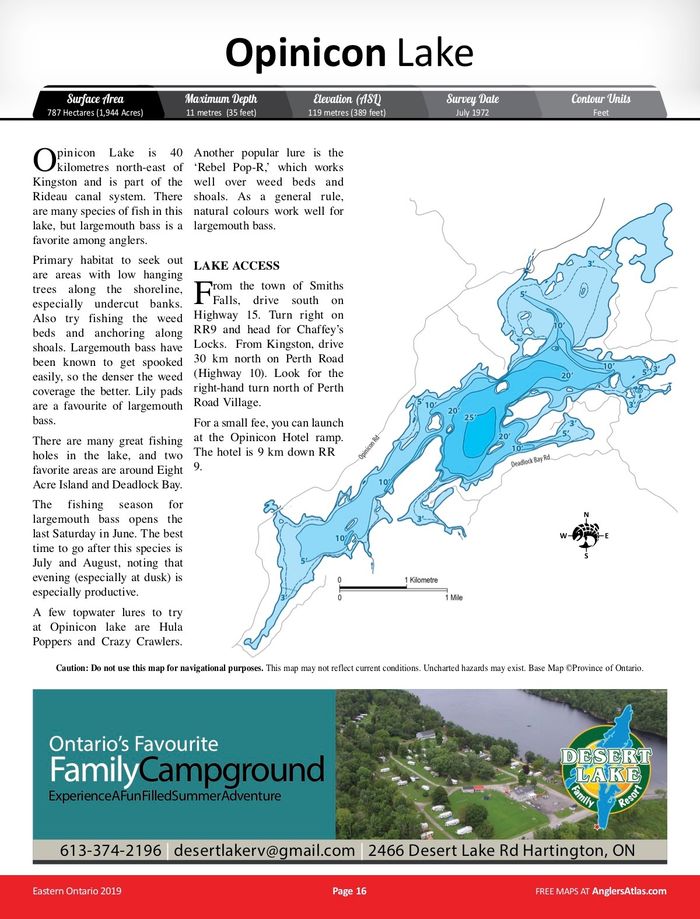
Opinicon Lake is 40 kilometres north-east of Kingston and is part of the Rideau canal system. There are many species of fish in this lake, but largemouth bass is a favorite among anglers.
Primary habitat to seek out are areas with low hanging trees along the shoreline, especially undercut banks. Also try fishing the weed beds and anchoring along shoals. Largemouth bass have been known to get spooked easily, so the denser the weed coverage the better. Lily pads are a favourite of largemouth bass.
There are many great fishing holes in the lake, and two favorite areas are around Eight Acre Island and Deadlock Bay.
The fishing season for largemouth bass opens the last Saturday in June. The best time to go after this species is July and August, noting that evening (especially at dusk) is especially productive.
A few topwater lures to try at Opinicon lake are Hula Poppers and Crazy Crawlers. Another popular lure is the ‘Rebel Pop-R,’ which works well over weed beds and shoals. As a general rule, natural colours work well for largemouth bass.
LAKE ACCESS
From the town of Smiths Falls, drive south on Highway 15. Turn right on RR9 and head for Chaffey’s Locks. From Kingston, drive 30 km north on Perth Road (Highway 10). Look for the right-hand turn north of Perth Road Village.
For a small fee, you can launch at the Opinicon Hotel ramp. The hotel is 9 km down RR 9.
7 years ago